


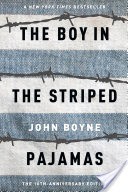
“In fact everywhere he looked, all he could see was two different types of people: either happy, laughing, shouting soldiers in their uniforms or unhappy, crying people in their striped pajamas...“

“In fact everywhere he looked, all he could see was two different types of people: either happy, laughing, shouting soldiers in their uniforms or unhappy, crying people in their striped pajamas...“
The Boy in the Striped Pajamas could be used in my classroom to teach historical fiction and help students understand the Holocaust in an age-appropriate way. An activity to include would be a perspective journal, where students write short entries from either Bruno‘s or Shmuel‘s point of view to explore how each boy experiences the world differently. Overall, the book offers a powerful way to blend reading, history, and emotional learning.
 pick
pickThe Boy in the Striped Pajamas by John Boyne is a powerful work of historical fiction that tells the story of the Holocaust through the eyes of nine-year-old, Bruno. When Bruno moves to “Out-With,” he unknowingly lives beside a concentration camp where he meets Shmuel, a Jewish boy on the other side of the fence. Their unlikely friendship highlights the difference between Bruno‘s innocence and the harsh realities Shmuel faces as a Jewish boy.
“Did you ever see anything quite as ugly as that great creature?... He is a disgrace to any brood...“
I can use “The Ugly Duckling“ to teach themes like kindness, acceptance, and self-esteem. Students can discuss how the duckling feels, write about times they felt different, or create artwork showing their “inner swan.” I can also use it to explore story structure, character growth, and sequencing. These activities help students connect emotionally while building reading and writing skills.
pick“The Ugly Duckling“ by Jerry Pinkney is a fairy tale about a duckling who is rejected for being different, only to grow into a beautiful swan. It fits the fairy tale category because it includes transformation, emotional struggle, and a hopeful ending. With detailed illustrations and a timeless message about self-acceptance and inner beauty, the story teaches that true worth is found within, not in outward appearances.
“To this day she goes about whining in people's ears: “Zeee! Is everyone still angry at me?“ When she does that, she gets an honest answer.“
I can use Why Mosquitoes Buzz in People‘s Ears to teach cause and effect, sequencing, and moral lessons. Students can retell the story with puppets or masks, act out the animal chain reaction, or create their own pourquoi tales. I can also connect it to a science lesson on insects or sound. These hands-on and activities that span over different subjects, but integrated, help students engage with both the story and its deeper meanings.
pickWhy Mosquitoes Buzz in People‘s Ears by Verna Aardema is a West African pourquoi tale that explains why mosquitoes annoy people. A mosquito tells a lie, causing a chain reaction of events that ends in tragedy. The animals hold a meeting to uncover the truth. This tale fits the pourquoi category because it explains a natural phenomenon through storytelling rooted in cultural tradition and moral lessons.
“Once again the girl rode beside the spotted stallion. They were proud and happy together.“
I can use The Girl Who Loved Wild Horses to teach about Native American culture, pourquoi tales, and respect for nature. It‘s great for discussing themes like freedom, belonging, and our connection to animals. I can also use it during a folklore unit, have students write their own pourquoi tales, or explore the artwork to connect literacy with visual arts and cultural studies.
 so-so
so-soThe Girl Who Loved Wild Horses by Paul Goble is a Native American pourquoi tale that explains the deep bond between a girl and wild horses. She feels more at home with them than with her people. After a storm separates her from her village, she chooses to stay with the horses forever. This tale fits the traditional literature category as a pourquoi story, explaining a cultural belief about the origin of wild horse spirits.
“My wrist is fine. But I didn't just fall out of bed, I fell off a cliff.“
I could use this book to support reading skills and social-emotional learning in my classroom. My students can discuss how Karen handles frustration and relate it to their own experiences. The graphic novel format helps me teach them how to read panels and understand emotions through images. I can also use it as a writing or art activity, allowing students to express feelings and build empathy while improving comprehension.
pickIn Karen‘s Worst Day, the graphic novel explores complex emotions like frustration and anger in a way that‘s easy for young readers to understand. Through expressive illustrations and simple dialogue, it shows how Karen‘s feelings build up and how she learns to handle them. The visuals help kids recognize emotions and consequences, making mature themes like empathy and self-control accessible and relatable.
“So the wolf huffed, and he puffed, and he blew the house in...“Hey! He blew me right out of the story!““
In this lesson using The Three Pigs by David Wiesner, students will explore how breaking traditional story structure can spark creativity. After reading, they‘ll discuss how the pigs “step out” of their story. Students will then create their own fractured fairy tale by choosing a classic story and imagining what would happen if the characters left the plot. Students can use color and this style to captivate their audience in their own images.
pick“The Three Pigs“, David Wiesner and published in 2001, uses shape and composition to break traditional storytelling. As the pigs escape their story, the shapes of panels bend, twist, and fall apart, showing their movement between story worlds. Shifts in color and value reflect changes in setting and the characters jump out of the story. Playful lines and dynamic composition highlight imagination, freedom, and the power of creating your own path.
“Music swirled, twirled, and soared on wings of sound.“
After reading Dancing Hands, students will explore how music can express emotions and bring comfort during difficult times. They will discuss Teresa resilience and creativity, then reflect on times they used art or music to express feelings. If they haven't, how can they? They should have some ideas after reading. Then, students can draw or write about how they can or do share emotions creatively, connecting personally with Teresa‘s story.
pickThis is a picture book published in 2019, illustrated by Rafael López. This book uses vibrant colors, flowing lines, and composition to reflect Teresa‘s passion and the expressive power of music. The swirling shapes and lines around her hands visually represent sound and emotion. Bright colors convey joy and creativity, while darker values show moments of struggle. The contrast in composition shows her journey from hardship to hope in music.
In my future classroom, I would use “Inch by Inch,“ by Leo Lionni, to explore the concept of measurement and problem-solving. After reading the story, students will use rulers to measure objects around the classroom, just like the inchworm in the book. They'll record their findings and discuss how measuring helps solve problems. The class will also reflect on how the inchworm uses creativity to problem solve.
so-so“Inch by Inch“ by Leo Lionni, published in 1960, uses colors, spacing, and vertical lines to create meaning in the illustrations. This children's picture book utilities water colors for colors, but vertical lines to show comparisons of sizes and really analyze the different in length throughout the story. It scale of zooming in and out, conveys the story while focusing on size and color to convey its message.
“Dad will not and smile and eat with his eyes half closed. “Good fish,“ he will say to me.“
pick“A Different Pond“, illustrated by Thi Bui and published in 2017 is a picture book that uses color masterfully to evoke mood and deepen the emotional tone of the story. The grays in the early morning setting, creating a calm atmosphere that matches the quiet bond between father and son. Warm hues appear sparingly, highlighting moments of comfort and human connection. This cool and warm tones shows hardships family faces while love shines.
“A Different Pond“ illustrated by Thi Bui could be used in my classroom as a lesson to teach how illustrations show emotion and mood. Students explore how color choices reflect feelings, then create their own drawings using colors to express a memory or special moment from their lives. They will then write a few sentences on what the memory and why the colors were chosen and why. This can be shared to the class as a group.
“Jasper Rabbit would never get into the carrot patch ever again!“
I would use “Creepy Carrots!“ illustrated by Peter Brown to teach the use of color and have my students write a short story. I would have them pick one color to use for illustrations, as well as, using black and white. This would teach them the use of color and how a certain color can make the audience feel. They don't have to use creepy, they can create a whole new story with a new mood. This would teach students writing and the use of art.
pick“Creepy Carrots!“ written by Aaron Reynolds and illustrated by Peter Brown, is a picture book that was on honored as a Caldecott book and was published in 2012. This children's picture book uses the images with pops of one color (orange) to convey the emotions and mood of creepiness to come out of the page. This book is seen to be black and white, but the orange from the carrots gives it a timeless look and helps tell the story Peter Brown wanted.
As a teacher, I would use this book to show students how imagery can tell a story. This could also be used to show how to be kind to new students and do a lesson on culture and what food is important in your family. This would show the similarities and differences in culture and what is important to each student and their family. Students could also create a picture of what food is love to them.
pick“Home in a Lunchbox“ by Cherry Mo is a picture book that is honored as a Caldecott book of 2025. This story is a great way to show a child being new in school, with little to no English speaking. This book shows how food can remind the brain and heart of home and safe. With minimal words, the colors and pictures show so much imagery to tell the story and depict the story in such a compelling way.
“TAKE COURAGE! I must keep the black snake away from my village‘s water. I must rally my people together!”
I could use this book with my students to teach them about the oil leak in the water, but I can also show them how communities come together and can protect our environment. It is so important to keep our communities and world safe and preserve what we have. This will teach my students to protect our resources and nature and how important that is. There are so many activities that could be done regarding this.
pickThis is a Coldecott Award Winning book that was published in 2020. This children's book related to the oil leak and fighting the “black snake“ that is in the pipes in the water. It shows the community fighting together to help the cause and each other to fight against something that could potentially hurt them. This shows history and rallying together.
“One winter morning Peter woke up and looked out the window. Snow had fallen during the night. It covered everything as far as he could see.”
This is a great book that my students could relate to. I would introduce this book when the seasons are changing into winter and the snow is about to come or is maybe the first day with snowfall. This could teach my students about the seasons, but also get them excited for how they could see this magical season and find the joy in the little things, even though it will be so cold!!!
pickThis is a Coldecott Winning book that is published in 1962. This book shows the appreciation of the little things and how the little boy Peter loves a magical day in the snow and is exemplified through the pages with his bright red suit that jumps out in the illustrations. He dreams of no snow, but wakes up happy to see the snow is still there for him to play in, just enjoying the small moments.
“Chicken.” “Yes, Papa?” “You did it again. You interrupted two stories, and you‘re not even sleepy!”
In my classroom, I would show this story to introduce protagonists that relate to students. This is also a book that will be very engaging and funny for students, so we could do many activities that include the interrupting chicken and since he created his own story, my students can create their own story that maybe even has them or the chicken as their protagonist!
pickThis is a Coldecott Award Winning book published in 2010. This book is a funny children's book that shows a chicken trying to go to sleep with a bedtime story from his father. He cannot stop interrupting his father every story they try. He finally makes up his own story for his father and then gets interrupted by his dad when he starts snoring and went to sleep. This is a funny book that students will enjoy.
“She was not going to move. She had not planned it. She had not plotted it. She just knew she was not going to move.”
This book would be great when introducing the Civil Rights Movement to students and showing it in a way with visuals and specific individuals being displayed. By telling the story of Rosa Parks, students can understand what this movement was and how segregated the world was at this time. Rosa Parks is a known historical figure that students may have heard of, but will now know her story.
pick“Rosa“ is a Coldecott Award Winning book that was published in 2005. This book depicts the story of Rosa Parks including history and family dynamic. It shows her story of when she chose not to give up her seat and teaches what happened on the bus and what happened afterwards, including history on segregation at that time and why people believed she could not sit at the front of the bus. It shows her arrest and the boycott that happened after.
This book is a great way to show students the responsibility they have as a learner and teacher. Even children are teaching others. This book shows that, as well as, showing family dynamics and it may show a family that does not replicate their own. This book also involves another language which is great for students to see.
pickThis is a Coldecott Winning Book that was published in 2024. This book shows the dynamic between siblings and how we are always teaching each other, even when we are unaware of it. It shows an argument and yelling, but a great ending with love and acceptance of each other and the dynamic. This book is great for students with siblings and showing family dynamics and how people effect people, even children.
“Sometimes when your surrounded by dirt, your a better witness for what's beautiful.“
This would be a great introduction book to different backgrounds of students and that not every family looks the same. It is important for student to understand that differences and uniqueness is great and should always be respected. Reading this book would give these students a great idea on diversity and differences in maybe even classmates and friends.

